How to Choose Between Transistor and Buzzsprout in 2025
Over 58,000 podcasters search for “Transistor vs Buzzsprout” every month, according to Bing Webmaster data. That’s not curiosity. That’s decision paralysis.
Both platforms are excellent podcast hosts, but they operate on completely different pricing models. Transistor charges based on downloads (20,000 for $19/month, then jumps to $49 for 100,000). Buzzsprout charges based on upload hours (4 hours for $19/month, 15 hours for $39). Neither approach is inherently better, but one will cost you significantly more as you grow.
This comparison breaks down the real costs at different scales, honest pros and cons of each platform, and a decision framework based on your podcast’s stage. Whether you’re publishing your first episode or managing a network, you’ll know exactly which platform makes sense for your situation (and when to consider an unlimited alternative like VNYL).
Quick Takeaways:
- Transistor = unlimited shows, download-based pricing tiers ($228-$1,188/year as you scale)
- Buzzsprout = beginner-friendly, upload hour caps (4hrs/$19 to 35hrs/$79 monthly)
- Break-even analysis: Transistor wins for networks, Buzzsprout wins for simple weekly shows under 15K downloads
- VNYL alternative: Unlimited storage and downloads at $90/year (no caps, no tier jumps)
- Choose based on 12-month growth goals, not just today’s stats (migration costs time and subscribers)
What’s the Core Difference Between Transistor and Buzzsprout?
The fundamental difference isn’t features or quality. It’s how they charge you, and what they limit.
Transistor’s Download-Based Pricing Model
Transistor’s pricing structure centers on monthly downloads. You start at $19/month for 20,000 downloads. When you exceed that, you’re automatically upgraded to $49/month for 100,000 downloads. Hit 100,001 downloads and you jump to $99/month for 250,000.
The tier system creates predictable costs until you cross a threshold. Then your hosting bill suddenly increases by 158% to 260%. One viral episode can trigger a mid-month upgrade you didn’t budget for.
What you get at every tier: unlimited podcasts per account, unlimited team members, unlimited storage, and unlimited episodes. The only cap is downloads. If you’re running a podcast network or planning multiple shows, Transistor’s unlimited shows feature is massive. You can host 2 shows or 50 shows on one $19/month account (until you exceed download limits).
Transistor’s advanced features include YouTube auto-posting (converts your audio to video automatically), team collaboration tools, and IAB-certified analytics on Professional plans and above. The platform targets professional podcasters and networks who need polish and are willing to pay for success.
Buzzsprout’s Upload Hour Limit Model
Buzzsprout caps monthly uploads, not downloads. You get 4 hours of upload time for $19/month, 15 hours for $39/month, or 35 hours for $79/month. Your hours reset each month. Upload 4 hours in January, you get another 4 hours in February.
The math works fine for weekly 30-minute shows (2 hours monthly). It breaks down when you want to upload bonus content, launch a second show, or migrate your back catalog. Suddenly you need the $39 or $79 tier just to upload more content, regardless of your actual audience size.
What’s truly unlimited: downloads. Buzzsprout doesn’t care if you get 5,000 downloads or 500,000. You pay the same based on upload hours. This inverts Transistor’s model. Buzzsprout punishes content volume, not audience growth.
Buzzsprout’s features focus on beginners: Magic Mastering (auto-levels your audio like an Instagram filter), guided setup wizards, directory submission assistance, and excellent support. The platform removes friction for new podcasters who want simple over advanced.
The Pricing Philosophy Clash
Transistor charges for success. More downloads means you’re growing, which means you pay more. The model assumes growth should fund itself through monetization, but many podcasters hit 25,000 downloads before landing their first sponsor.
Buzzsprout charges for volume. More content means higher tiers, regardless of whether anyone listens. You could have 100,000 downloads monthly but still pay $19 if you only upload 4 hours per month. Or you could have 1,000 downloads but pay $79 because you upload 30 hours monthly across multiple shows.
Neither model is truly unlimited. Transistor caps downloads, Buzzsprout caps upload hours. Both force strategic decisions about how much to publish, when to promote, and whether to delete old content.
Quick Takeaway: Transistor limits downloads (pay more as you grow), Buzzsprout limits upload hours (pay more as you create). Pick which constraint matters less to your podcast.
Transistor vs Buzzsprout Pricing: The Real Cost at Scale
Let’s run the math at different audience sizes. Here’s what you’ll actually pay annually as your podcast grows.
Cost Comparison at 5K, 25K, 50K, 100K Downloads
Assumptions: Weekly 45-minute episodes (3 hours monthly upload), single podcast.
| Monthly Downloads | Transistor Annual Cost | Buzzsprout Annual Cost | VNYL Annual Cost |
|---|---|---|---|
| 5,000 | $228 (Starter: 20K limit) | $228 (4hrs sufficient) | $90 |
| 25,000 | $588 (Pro: 100K limit) | $228 (4hrs sufficient) | $90 |
| 50,000 | $588 (Pro: 100K limit) | $468 (need 15hrs for back catalog) | $90 |
| 100,000 | $1,188 (Business: 250K limit) | $948 (need 35hrs if running network) | $90 |
The pattern becomes clear. At low downloads (5K), both platforms cost the same. At medium downloads (25K), Buzzsprout stays cheaper if you’re not uploading extra content. At high downloads (100K), Transistor becomes very expensive, but Buzzsprout also climbs if you’re running multiple shows.
VNYL’s flat pricing ($90/year) beats both at every scale above 15,000 downloads. The break-even point where unlimited makes sense is around 15-20K monthly downloads. Above that, you’re paying $138-$1,098 more per year on tiered platforms.
Hidden Costs You Won’t See on Pricing Pages
Transistor’s mid-month tier jumps: You’re on the $19 Starter plan, averaging 18,000 downloads monthly. Your latest episode goes viral and hits the front page of Reddit. You cross 20,000 downloads on day 12 of the month. Transistor automatically upgrades you to the $49 Professional plan and charges your card the $30 difference. No warning, no opt-in. Just a surprise charge.
Next month, if you drop back to 18,000 downloads, you can manually downgrade. But most podcasters don’t. They hit the cap again eventually, so they stay upgraded. One viral episode costs you $360/year in permanent tier increases.
Buzzsprout’s back catalog problem: You’re migrating from another platform with 50 episodes at 45 minutes each. That’s 37.5 hours total. On Buzzsprout’s $19 plan (4 hours monthly), you’d need to spread that migration across 10 months. Most podcasters upgrade to the $79 plan ($948/year) temporarily just to upload their catalog faster.
The hidden cost? You stay upgraded because launching a second show or adding bonus content pushes you over 4 hours monthly anyway. What looked like a $19/month platform becomes a $79/month platform once you commit.
Migration costs when you outgrow either platform: Switching podcast hosts takes 2-4 weeks. You need to export episodes, upload to the new platform, update RSS feeds across all directories, and monitor for broken links. During migration, 5-10% of subscribers don’t make the transition. They don’t resubscribe on the new feed. You lose listeners permanently.
The hidden cost isn’t just time (10-20 hours of work). It’s subscriber drop-off and the risk of broken links damaging your evergreen content’s SEO value.
Break-Even Analysis: When Does Each Win?
Buzzsprout wins if:
- You publish weekly 30-minute episodes (2 hours monthly)
- You have one podcast with no plans for multiple shows
- You’re under 15,000 downloads monthly and staying there
- You value simplicity and guided setup over advanced features
At this profile, Buzzsprout costs $228/year. Transistor costs $228/year. They tie on price, but Buzzsprout’s onboarding is significantly better for beginners.
Transistor wins if:
- You’re running 2+ podcasts (unlimited shows on one account)
- You need team collaboration (unlimited members)
- You want YouTube auto-posting and advanced analytics
- You’re willing to pay $588-$1,188/year for professional features
At this profile, Transistor’s multi-show support and team features justify the cost. Buzzsprout would require multiple accounts or severely limiting your content.
VNYL wins if:
- You’re planning growth beyond 20K downloads
- You want unlimited hosting at predictable cost ($90/year)
- You’re migrating with a large back catalog (50+ episodes)
- You run 2-30 shows and hate tier anxiety
At this profile, unlimited hosting saves $138-$1,098 annually compared to tiered platforms. The savings compound over 24 months, especially for networks.
Quick Takeaway: Under 15K downloads with simple needs? Both platforms tie. Networks or growth plans? Transistor or unlimited. Budget-conscious with growth goals? Unlimited wins.
 Tiered pricing models create cost stairs as you grow, while unlimited keeps costs flat
Feature-by-Feature Comparison: What Actually Matters
Beyond pricing, here’s how the platforms compare across 14 critical criteria:
| Feature | Transistor | Buzzsprout | VNYL |
|---|---|---|---|
| Storage | Unlimited | Unlimited | Unlimited |
| Downloads | 20K-250K+ tiers | Unlimited | Unlimited |
| Upload Hours | Unlimited | 4hrs-35hrs/month | Unlimited |
| Shows per Account | Unlimited | 1-6 depending on plan | 2-30 depending on plan |
| Team Members | Unlimited | Limited (2-5) | Unlimited |
| IAB Analytics | ✓ Pro plans ($49+) | ✗ Not offered | ✓ All plans |
| YouTube Auto-Post | ✓ All plans | ✗ Not offered | Coming soon |
| Dynamic Ads | ✓ Pro plans ($49+) | ✗ Not offered | Coming soon |
| Magic Mastering | ✗ Not offered | ✓ All plans | ✗ Not offered |
| Guided Setup | Basic self-service | ✓ Best-in-class | Standard |
| Support Quality | Email, good response | Email, excellent | Email + Discord |
| Website Builder | ✓ Beautiful | ✓ Good | ✓ Standard |
| Migration Help | Self-service docs | ✓ Assisted | Assisted |
| Starting Price | $19/mo | $19/mo | $7.50/mo ($90/yr) |
Patterns to notice:
- Transistor wins on professional features (YouTube, dynamic ads, IAB analytics)
- Buzzsprout wins on beginner experience (Magic Mastering, guided setup, migration help)
- VNYL wins on unlimited fundamentals (downloads, storage, uploads) at lowest price
- IAB Tech Lab’s podcast measurement standards are only available on Transistor Pro plans and VNYL, not Buzzsprout at any tier
Transistor’s Strengths: When It Wins
Let’s be honest about where Transistor excels. These aren’t marketing claims. These are features that save hours weekly.
Unlimited Shows = Network-Ready from Day One
Transistor supports unlimited podcasts per account at every pricing tier. You can host 2 shows or 50 shows for the same $19/month (until you exceed download limits across all shows combined).
This is massive for podcast networks, agencies managing client shows, or creators testing multiple formats. One login, one bill, one dashboard to manage everything. No juggling multiple accounts or splitting costs.
Buzzsprout technically supports multiple shows, but the upload hour caps make it impractical. Two weekly shows at 45 minutes each = 6 hours monthly. You immediately need the $39 plan minimum. Three shows = $79 plan required.
Transistor’s approach: pay once, host everything, scale with downloads (not number of shows).
Advanced Analytics for Serious Podcasters
Transistor’s analytics go deeper than standard platforms. You get listener trends over time, geographic breakdowns, listening app distribution, and episode-by-episode performance comparisons.
The Professional plan ($49+) includes IAB certification, which matters for monetization. When you approach sponsors or ad networks, they ask: “Are your analytics IAB-certified?” If no, they discount your numbers by 15-20% or walk away. Transistor’s IAB compliance means advertisers trust your data.
Buzzsprout offers standard analytics (downloads, locations, apps) but no IAB certification at any price point. For serious monetization, this is a dealbreaker.
YouTube Auto-Posting Saves Hours Weekly
Transistor’s YouTube auto-posting feature converts your audio to video automatically, adds a background image, and publishes to your YouTube channel. Every episode you publish appears on YouTube without extra work.
Why this matters: YouTube is the second-largest podcast platform after Spotify. Many podcasters manually upload audio to YouTube with static images. That’s 15-30 minutes per episode. Transistor eliminates that workflow entirely.
Buzzsprout doesn’t offer this. You export, manually upload to YouTube, add metadata, and publish. It’s doable, but it’s friction.
Quick Takeaway: Transistor is the professional choice for multi-show creators, teams needing collaboration, and podcasters who value time-saving automation.
Buzzsprout’s Strengths: When It Wins
Now let’s be honest about where Buzzsprout excels. These features genuinely matter for beginners.
Best Onboarding Experience in Podcasting
Buzzsprout’s setup wizard walks you through every step: RSS feed creation, artwork optimization (it checks dimensions automatically), show description best practices, and directory submission. You’re never staring at a blank form wondering “what goes here?”
The platform celebrates your progress with milestone emails (“You published your first episode!”) and achievement badges. It sounds gimmicky, but for beginners, that positive reinforcement matters. Podcasting is lonely work. Buzzsprout makes it feel less intimidating.
Transistor assumes you know what you’re doing. The interface is clean and powerful, but you’re expected to understand RSS feeds, metadata, and distribution already. There’s no hand-holding.
Magic Mastering: The Instagram Filter for Podcasts
Magic Mastering auto-levels your audio to industry standards. It adjusts volume, balances frequencies, and optimizes for spoken word. You upload raw audio, Buzzsprout processes it, and your episode sounds professional without learning audio engineering.
For beginners recording on USB mics in untreated rooms, this is game-changing. You don’t need to learn Audacity, hire an editor, or worry about technical specs. Buzzsprout handles it.
Transistor doesn’t offer audio processing. You’re expected to upload production-ready files. Most professional podcasters prefer this (they want full control), but beginners struggle.
Excellent Support Team (Award-Winning)
Buzzsprout’s support team is consistently rated the best in podcasting. Email responses come within hours, not days. The answers are detailed, patient, and include screenshots when needed.
The Buzzsprout Facebook community is active with 20,000+ members helping each other. The Buzzsprout team participates daily, answering questions and troubleshooting issues.
Transistor’s support is good (responsive email, helpful documentation), but Buzzsprout’s support is legendary. If you’re new to podcasting and need guidance, this matters enormously.
Quick Takeaway: Buzzsprout removes friction for beginners who want simplicity, guidance, and confidence that they’re doing it right.
What Are the Biggest Weaknesses of Each Platform?
Let’s talk about what’s frustrating. Every platform has trade-offs.
Transistor’s Download Caps Punish Growth
The download-based pricing model creates anxiety. You’re watching your analytics not to understand your audience, but to monitor when you’ll hit the tier cap.
When you cross 20,000 downloads, you jump from $19/month to $49/month. That’s a 158% price increase for success. The tier jump happens automatically, mid-month, with no warning beyond an email notification. Your credit card is charged the difference immediately.
For bootstrapped podcasters, this is painful. You finally build an audience, and your reward is a surprise $30 charge. One viral episode (Reddit front page, podcast feature, influencer share) can trigger a permanent tier upgrade that costs $360/year.
The model works fine if you have predictable, steady growth. It punishes volatility and viral moments.
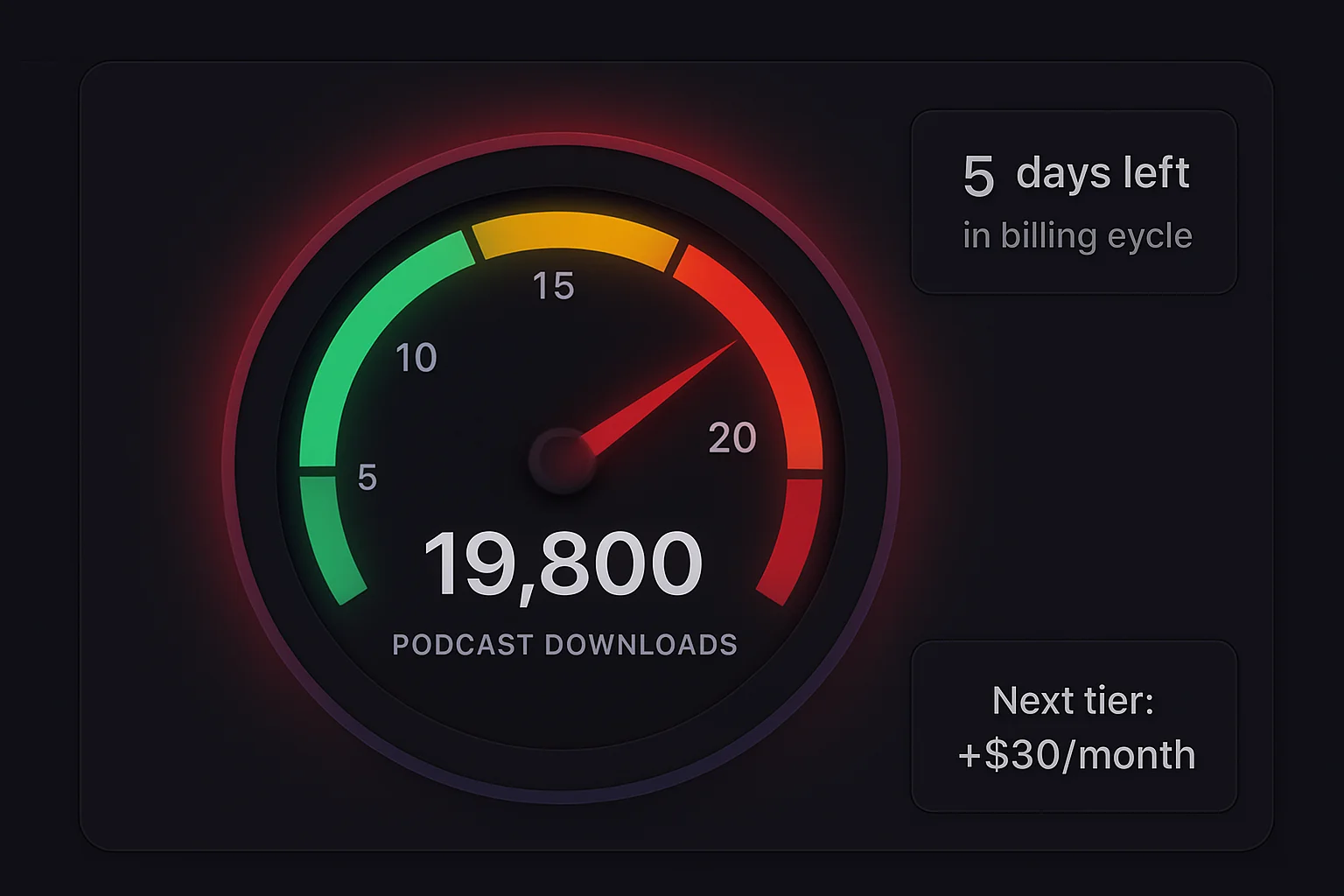 Watching your download counter approach the tier limit creates stress instead of celebrating growth
Buzzsprout’s Upload Hour Limits Block Experimentation
The 4-hour monthly cap on the base plan sounds reasonable until you do the math. Weekly 30-minute episodes = 2 hours monthly. Add one bonus episode or one interview that runs long (60 minutes) and you’ve burned through your allowance.
You can’t upload your back catalog without upgrading. Migrating from another platform with 50 episodes? You’ll need months on the base plan or a temporary upgrade to the $79 plan just to move your content.
Multiple shows are impractical. Two weekly podcasts = 6 hours minimum monthly. You immediately need the $39 plan ($468/year). Three shows = $79 plan required ($948/year).
The model works for simple, consistent publishing schedules. It punishes experimentation, bonus content, and network growth.
Neither Offers True Unlimited Hosting
Both platforms use the word “unlimited” selectively. Transistor advertises “unlimited podcasts” but caps downloads. Buzzsprout advertises “unlimited downloads” but caps upload hours.
True unlimited means no caps on storage, bandwidth, downloads, or upload hours. Neither platform offers that. Both force you into higher tiers as you scale, just on different metrics.
When you outgrow these platforms (and most serious podcasters eventually do), migration becomes necessary. That costs 2-4 weeks of work, risks subscriber drop-off, and breaks backlinks to old episodes.
Quick Takeaway: Transistor and Buzzsprout are excellent platforms, but both have growth ceilings. Plan for eventual migration or choose unlimited upfront.
VNYL Alternative: What If You Want Unlimited Everything?
Let’s talk about the third option that solves both pricing model frustrations.
How VNYL Combines the Best of Both
VNYL offers unlimited storage, unlimited downloads, and unlimited upload hours at $90/year (founder pricing during early access). No download tiers like Transistor. No upload hour caps like Buzzsprout. Just flat, predictable hosting that gets out of your way.
You can host 2-30 podcasts depending on plan tier (2 shows on Starter, 10 on Pro, 30 on Business), similar to Transistor’s multi-show support. Unlike Buzzsprout, there’s no upload math. Publish daily episodes or weekly episodes. Upload 2 hours monthly or 20 hours. You pay the same.
According to AWS S3 pricing data, cloud storage costs have dropped 85% since 2010. Bandwidth followed the same trajectory. The infrastructure economics that justified download caps and storage limits don’t exist anymore. VNYL passes those savings to creators instead of maximizing profit margins.
The result: unlimited hosting that actually means unlimited.
When VNYL Makes More Sense
Choose VNYL if:
- You’re planning growth beyond 20K downloads (saves $138-$498/year vs Transistor)
- You’re migrating with a back catalog (no upload hour limits to navigate)
- You run 2-30 shows and hate tier anxiety (flat pricing across all shows)
- You’re bootstrapped and need predictable costs ($7.50/month vs $19-79/month)
The break-even analysis is simple. At 25,000 downloads monthly:
- Transistor costs $588/year
- Buzzsprout costs $228/year (if simple weekly show)
- VNYL costs $90/year
Savings: $138-$498 annually. Over 24 months: $276-$996 saved.
VNYL’s Limitations (Honest Assessment)
Let’s be honest about what VNYL doesn’t have (yet):
- Show limits exist (2-30 per plan, not unlimited like Transistor)
- Newer platform (less brand recognition than Transistor/Buzzsprout)
- Some features still shipping (dynamic ads, YouTube auto-posting coming soon)
- No built-in ad marketplace (you’ll need to find sponsors independently)
- No Magic Mastering (you’ll need production-ready audio)
VNYL targets podcasters who want unlimited fundamentals (storage, downloads, bandwidth) without paying for advanced features they might not need yet. As we ship new features, founder pricing stays locked at $90/year for early adopters.
When we built VNYL, we asked: what would podcast hosting look like if we built it in 2025 using modern infrastructure, not legacy pricing from 2010? The answer: unlimited storage and bandwidth should be default, not premium features. Storage costs $0.023/GB. Bandwidth costs pennies. There’s no technical reason to cap downloads at 20,000 or charge per upload hour.
Quick Takeaway: VNYL removes download and storage limits at $90/year. Trade-off: show limits and fewer advanced features compared to Transistor.
Decision Framework: Which Should You Choose?
Stop comparing features you don’t need. Choose based on where your podcast is right now.
Choose Buzzsprout If:
You’re publishing your first 10 episodes and don’t know if you’ll stick with podcasting. You want hand-holding through setup, audio processing help (Magic Mastering), and a support team that celebrates your milestones.
You publish weekly 30-minute episodes (2 hours monthly), you have one podcast, and you’re under 15,000 downloads monthly. The 4-hour upload cap doesn’t constrain you, and the $228/year cost is predictable.
You value simplicity over advanced features. You don’t need IAB analytics, YouTube auto-posting, or team collaboration. You want to record, upload, and distribute without technical complexity.
Buzzsprout wins for: Complete beginners, simple weekly shows, simplicity seekers.
Choose Transistor If:
You’re launching multiple podcasts or managing a network. You need unlimited shows on one account, unlimited team members, and professional features like advanced analytics and YouTube auto-posting.
You’re willing to pay $588-$1,188/year for polish and automation. The download tiers don’t scare you because you’re planning to monetize early and let revenue cover hosting costs.
You need IAB-certified analytics for sponsor conversations. Advertisers require verification, and Transistor delivers it on Professional plans and above.
You’re an intermediate-to-advanced podcaster who values time-saving features over hand-holding. You understand RSS feeds, metadata, and distribution. You want powerful tools, not simplified workflows.
Transistor wins for: Podcast networks, professional creators, teams, IAB analytics needs.
Choose VNYL If:
You’re planning growth beyond 20K downloads in the next 12 months. You hate the idea of tier jumps punishing success. You want unlimited hosting at predictable cost that doesn’t scale with audience size.
You’re migrating from another platform with 50+ episodes in your back catalog. Upload hour limits (Buzzsprout) or tier anxiety (Transistor) make migration stressful. VNYL lets you upload everything on day one without math homework.
You run 2-30 podcasts and need multi-show support without tiered pricing. You’re bootstrapped and need to minimize costs while maintaining room to grow.
You prefer paying $90/year over $228-$948/year for the same fundamentals (unlimited storage, unlimited downloads). You’re okay with fewer advanced features during early access in exchange for locked-in founder pricing.
VNYL wins for: Growing shows, budget-conscious creators, networks (2-30 shows), back catalog migrations.
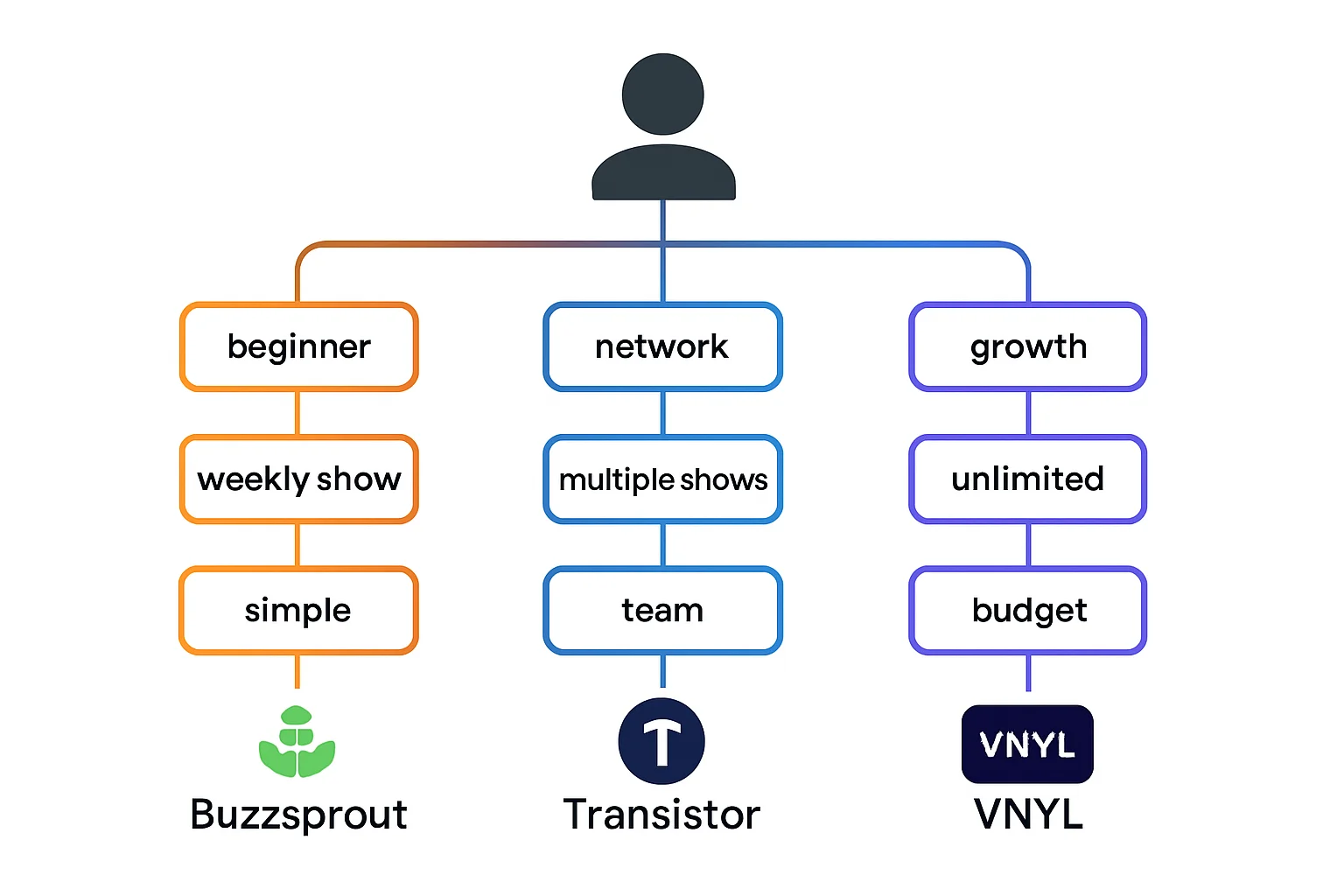 Three distinct paths based on your podcast’s stage and goals
Make Your Decision
The right podcast hosting platform depends on three factors: your current podcast size, your 12-month growth goal, and whether monetization matters now.
Here’s the decision framework:
If you’re testing podcasting and don’t know if you’ll stick with it, start with Buzzsprout. Remove financial barriers, get guided setup, and learn the basics. The $228/year cost is reasonable for peace of mind.
If you’re launching multiple shows or need professional features, choose Transistor. The $588-$1,188/year cost is justified by unlimited shows, team collaboration, YouTube auto-posting, and IAB analytics. Plan your monetization strategy to cover hosting costs.
If you’re planning growth from 5K to 50K downloads this year, choose VNYL. Lock in unlimited hosting at $90/year before you hit expensive tier jumps. Migration later costs time and subscribers. Choose for where you’ll be in 12 months, not just today.
The worst decision? Choosing based only on today’s needs, then migrating in 6 months when you outgrow the platform. Migration means broken links, subscriber drop-off, and 10-20 hours of technical work. Choose strategically now.
For a broader comparison beyond just these two platforms, check out our complete comparison of 10 podcast hosting platforms with detailed feature breakdowns and pricing at scale.
Want to understand why unlimited hosting makes economic sense in 2025? Read our deep dive into what unlimited podcast hosting really means and why cloud infrastructure changes have made artificial caps outdated.
Try VNYL free for 14 days with unlimited hosting and founder pricing. Lock in $90/year while early access lasts. No credit card required to test the platform.
Want more podcasting tips like these? Join our newsletter at vnyl.fm for weekly insights on growing your podcast without platform limitations.